Наверх
Software NIBELUNG
Interactive multimedia learning environment

About the program “Nibelung”

“Dialogue Nibelung” is a software product designed to transform a computer lab into an interactive multimedia environment and language lab. The program contains advanced functions for managing multimedia and web resources and can be used to teach a wide range of subjects. The convenient and intuitive interface of the program will make it easy to master and use it in the learning and teaching process.

The Nibelung software can be implemented into the educational process and effectively used for:

  • teaching foreign languages and Russian;
  • speech development;
  • training in computer technologies, for example, working with office programs;
  • teaching general education subjects;
  • presentations;
  • testing;
  • computer lab management.
  • distance learning (in networks using VPN)

The package includes:

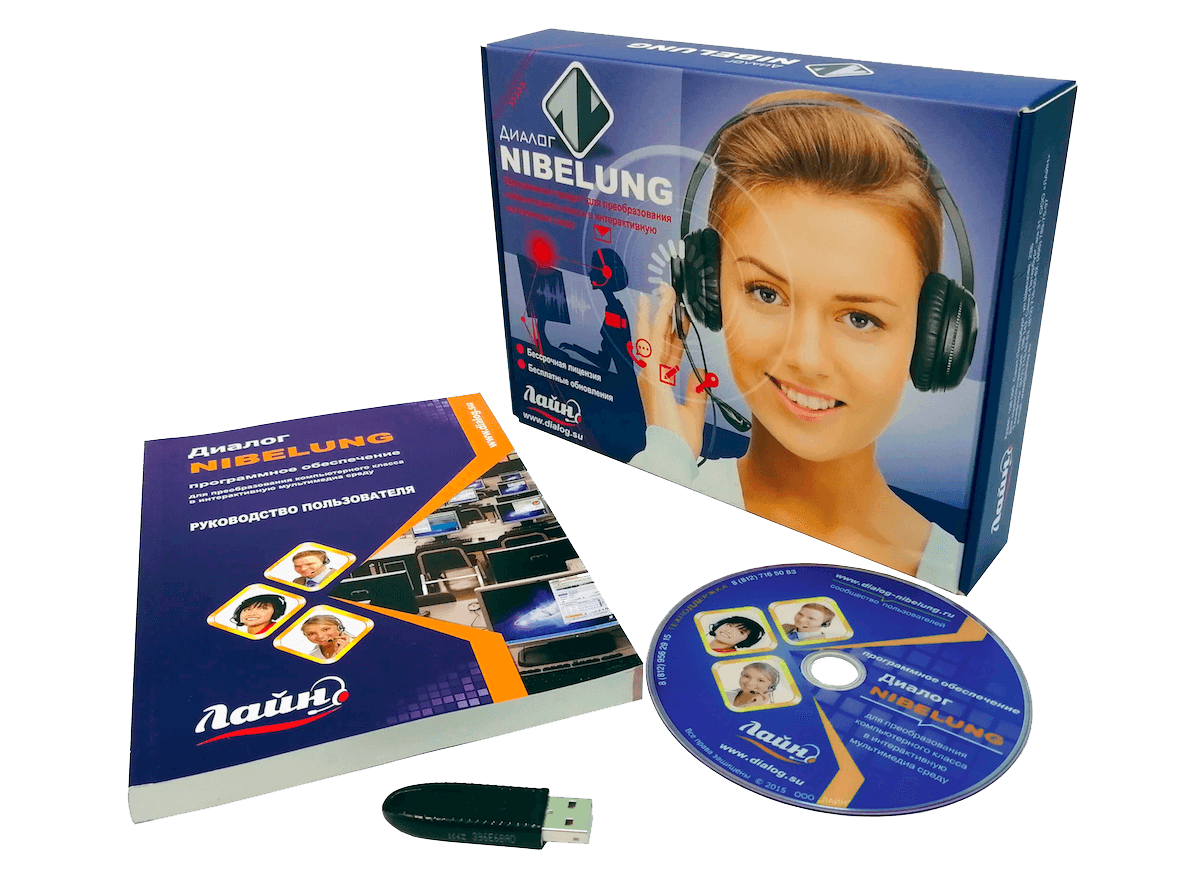
Installation disk, USB key, user manual, license

Software “Dialogue Nibelung”:

The main module of the Nibelung Dialogue program (installed on the teacher’s computer)
Client module (installed on the student’s computer)
  • will allow the teacher to make the most efficient use of teaching time, making classes more interesting and rich
  • substantially automates and parallelizes the process of conducting a lesson;
  • enrich training sessions with multimedia content without the need to use additional equipment;
  • will provide students with more material to study and expand the choice of materials for independent work (including through controlled use of Internet pages);
  • will provide the teacher with the necessary tools for effective interactive communication with students (sending short messages, chat sessions, listening, dialogue);
  • having the “Keychain” function (USB disk of the teacher), it will allow you to store settings, login data and files on one flash drive, and easily transfer them from computer to computer;
  • always provides the most up-to-date version of the program thanks to automatic updates via the Internet, as well as free technical support for users;
  • contains a built-in test system and a system of quick student surveys, greatly simplifying the monitoring and assessment of student knowledge;
  • provides a multi-user mode of operation, allowing you to combine the work of an unlimited number of teachers in one classroom with a computer class;

Easy to install and configure

“Dialogue Nibelung” is a purely software solution, easy to install and configure and does not require additional hardware.

When purchasing the Nibelung Dialogue software, you will receive an individual key for the required number of licenses (according to the number of computers in the classroom). For communication between classroom computers, you can use both local and wireless Wi-Fi networks.

Wi-Fi and Android support

The Nibelung Dialogue software includes client modules for systems running Android OS, which allows the use of mobile tablets, including student devices, in the learning process. The client for Android OS has similar capabilities of the module for Windows OS, with the exception of some functions due to limitations of the Android OS itself.

Testing system

An integral part of the “Dialogue NIBELUNG” software product is the testing system “Dialogue Nibelung NQuiz” – a special software package for creating and editing tests, conducting tests and analyzing the results by the teacher. Test questions can contain both text and various audio and video information, including images and materials from the Internet.

The program allows you to create questions of various types:

  • choose one correct answer;
  • selecting several correct answer options;
  • match;
  • arrange in the specified order;
  • insert missing words;
  • entering a text response from the keyboard;
  • record voice response

When creating a test, the teacher can:

  • set a time limit for answering a question;
  • limit the time for taking the test;
  • indicate the difficulty of the question in points;
  • set the maximum score.
  • specify the criteria for calculating the score
Simple Quiz
Simple Quiz
Simple Quiz
Диалог Nibelung NQuiz

Managing student computers

Students’ computers are controlled directly using the graphical interface of the teacher’s program. The graphical representation of the class can be easily edited in accordance with the real one by changing the size and relative position of the classrooms. The interface is customized using movable toolbars with changeable appearance and customizable menus. The standard window for viewing and editing document properties is similar to Microsoft Office.
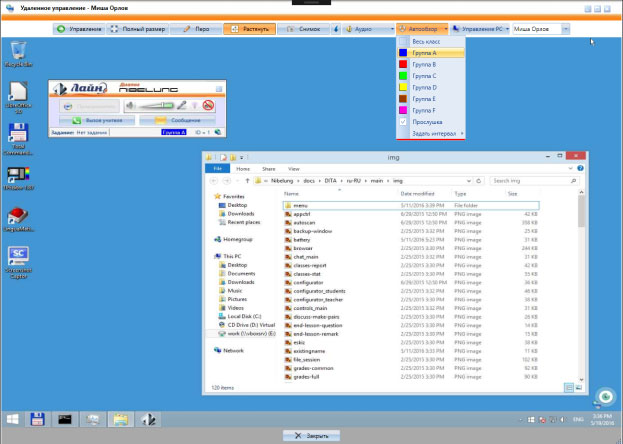

The teacher exercises full control of students’ personal computers from his workplace:

  • control interception;
  • launch applications;
  • input blocking;
  • power management;
  • controlled use of Internet pages as educational materials;
  • control of running programs;
  • editor for the list of allowed and prohibited programs;
  • editing shortcuts for launching programs;
  • controlled use of removable media;
  • automatic monitoring of student computers;
  • view thumbnails of selected or all students;
  • displays the screen of the teacher or selected student on all computers;
  • highlight information on your computer screen over an image using the Pen tool

The program uses a local network for communication between computers in the class. Audio and video materials and other files can be transmitted over a local network, and students’ personal computers can be fully controlled from the teacher’s workstation.

Class Journal

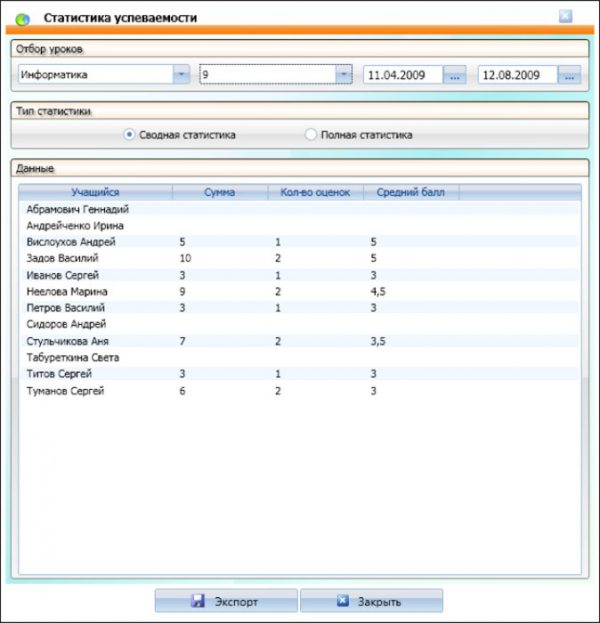
The Nibelung Dialogue program allows you to keep attendance and progress logs. Each teacher has his own journal. The teacher gains access to the control panel using a personal password. The system automatically recognizes the registered classes of this teacher. Class files, audio and video materials of teachers are stored in personal folders.

The program interface allows you to:

  • edit the visual representation of the class;
  • enter and change student names;
  • choose and change the topic of the lesson;
  • set the duration of the lesson and the warning time about its end;
  • register those present at the lesson;
  • give ratings;
  • view attendance and performance statistics in the database with the generation of reports in HTML format

When you start registering those present in a lesson, a corresponding window appears on the students’ computer monitors, in which they must confirm their presence and, if necessary, enter their last name and initials. After the registration process is completed, a window with the results is displayed on the teacher’s screen.
Interaction with students

Connected students can work individually, in pairs and in groups (up to 10 groups at a time). The teacher can secretly listen to the work of a selected student, pair or group.
Operating modes:

  • In Conversation mode the teacher can start a conversation with a selected student, pair or group.
  • In the “Run a program” mode the teacher launches programs for a selected group or the entire class.
  • In the “Record” mode the teacher records the microphone of a selected student, group or entire class on the hard drive of the students’ and teacher’s computers in WAV or MP3 formats. In addition, the teacher can record his conversation with the student (simultaneous recording of the microphone of the teacher and the student).
  • In Message mode the teacher and student can exchange instant text messages. A chat session can be started for the selected group.
  • In Self-Learning mode students work independently with various files and can record their voice.
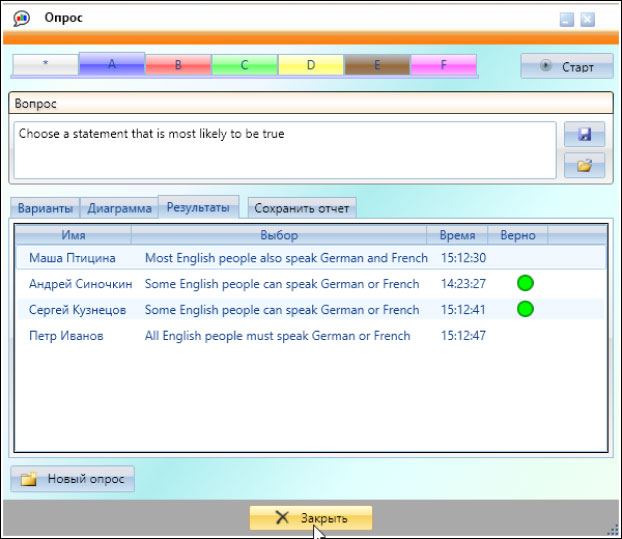
  • Quick Quiz mode allows you to send a question to a group of students or the whole class, to which the student must give the correct or preferred answer.
  • The “Interactive Whiteboard” mode is designed to provide collective or individual drawing for groups of students or the entire class.

Work in groups and pairs

At the moment, there are 7 different tasks that the teacher can combine in any combination depending on needs and in accordance with the developed lesson plan.

The teacher can:

  • organize students into groups (up to ten groups at a time) and pairs (within a group);
  • form pairs of students in different ways: randomly, by the choice of the teacher or the students themselves, by loading previously created sets of pairs;
  • make a general call to all students, listen to or engage in conversation with a selected student, pair or group;
  • record a conversation;
  • transfer audio information and other files to individual students and groups for further work

7 tasks

  • self-learning
  • discussion
  • screen transfer
  • Internet
  • working with files
  • testing
  • working with multimedia sources

Use of audio materials

The program allows you to simultaneously use up to 10 audio sources, including several sound cards or several built-in CD drives.

Various audio signals can be transmitted to students over the local network for listening:

  • audio files;
  • tracks from CDs;
  • line input of sound card;
  • microphone of the teacher or selected student;

Audio materials from any external source connected to the input of the sound card of the teacher’s computer, as well as any other broadcasts, including a microphone, can be digitized and saved for further work. The teacher can use one CD with educational materials, starting a separate track for each group.

Homework

The teacher can distribute files for independent work at home, as well as collect files (tasks) prepared by students. Homework is given to a group of students or individually. Information is automatically saved: who received the task, when and when it was submitted.

Learning with the Nibelung Dialogue software continues outside the classroom. The student can use the digital tape recorder and testing system at home to complete homework or self-study.

The teacher can also use the digital tape recorder, testing system and test maker outside of class to prepare for classes or check student work.
Screen transfer

Передача экрана

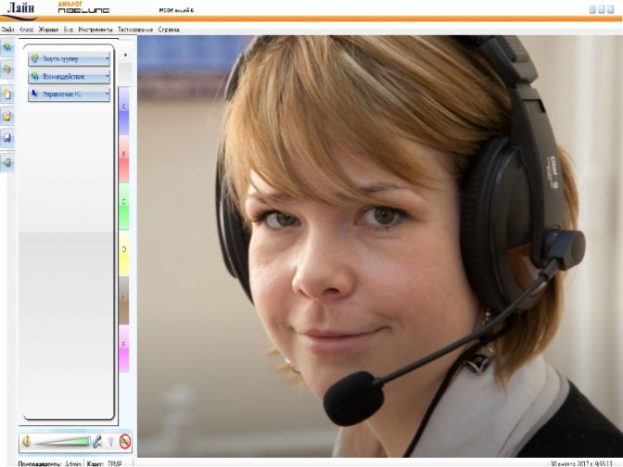
The teacher can transfer to students’ computers a display of the screen of any computer or one of the programs running on it. Screen sharing mode will allow students to see the material on their computer screen. While broadcasting, you can use the pen tool to highlight important information on the screen. A teacher can record a broadcast of his or a student’s screen and use it as a regular video file.

Student digital tape recorder

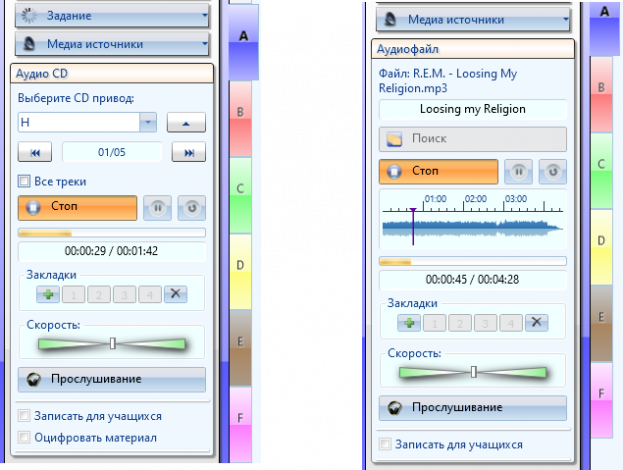
The graphical interface of the student module eliminates student interference in the operation of the system. Only the teacher can decide whether students should work independently with digital tape recorders. The student’s digital tape recorder allows you to play audio and video files in all common formats. A digital tape recorder has the functions of a regular tape recorder – playback, recording, repeat, etc. Additionally, a digital tape recorder allows the student to control the speed at which the audio file is played.

In the “Self-learning” mode, the student can select a file from the list proposed by the teacher, create bookmarks to listen to the file again from the moment marked on the track.

The student can record his voice, listen, compare his recording with a sample track and visually see the differences thanks to the presence of a graphical display of audio, as well as add or change subtitles to the recording.

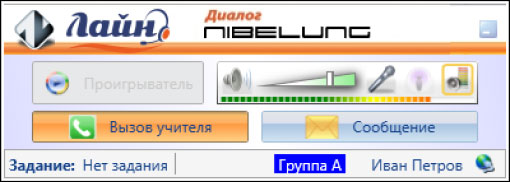
Each student’s client module has a “Call Teacher” button for the student to contact the teacher and a “Message” button for sending a question to the teacher in text form.
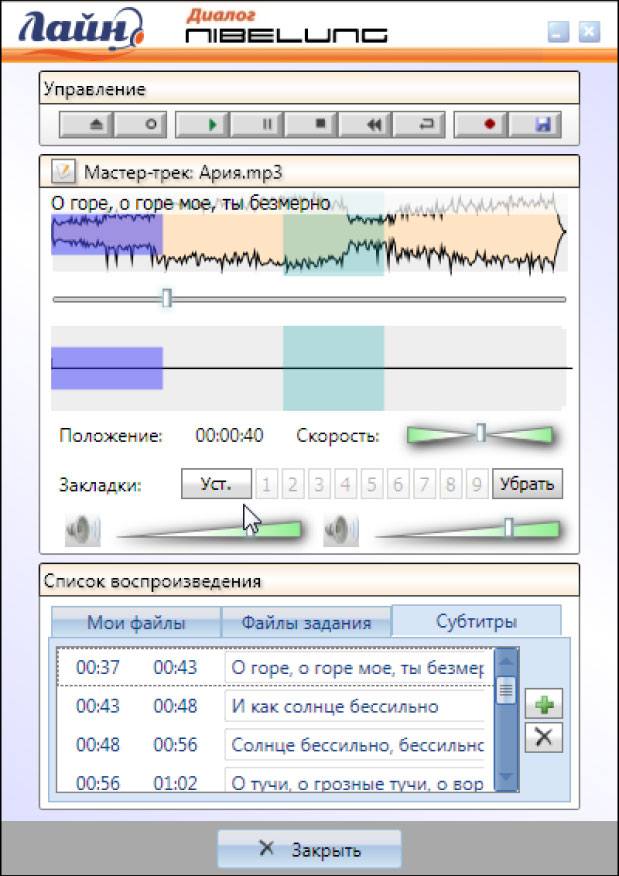
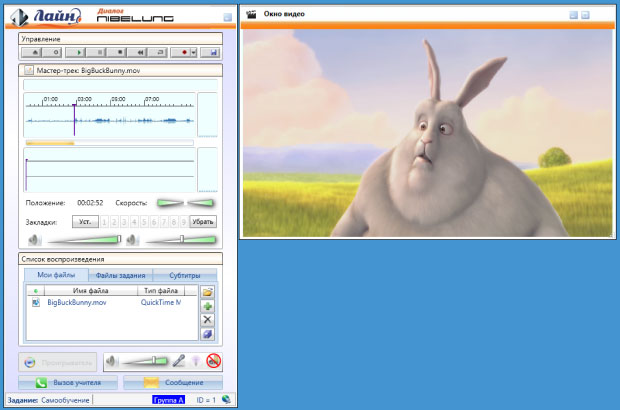
Цифровой магнитофон учащегося

Use of video materials

Использование видео-материалов

The teacher can broadcast video from his computer and control the broadcast like a regular tape recorder, for example: pause, rewind, set bookmarks, “loop” a fragment. You can broadcast any video files, DVDs, as well as external sources, such as a VCR, webcam, or video from YouTube. No additional software or hardware is required to transmit video. The built-in video converter allows you to digitize video materials for further use.

The built-in video converter allows you to digitize video materials for further use.